
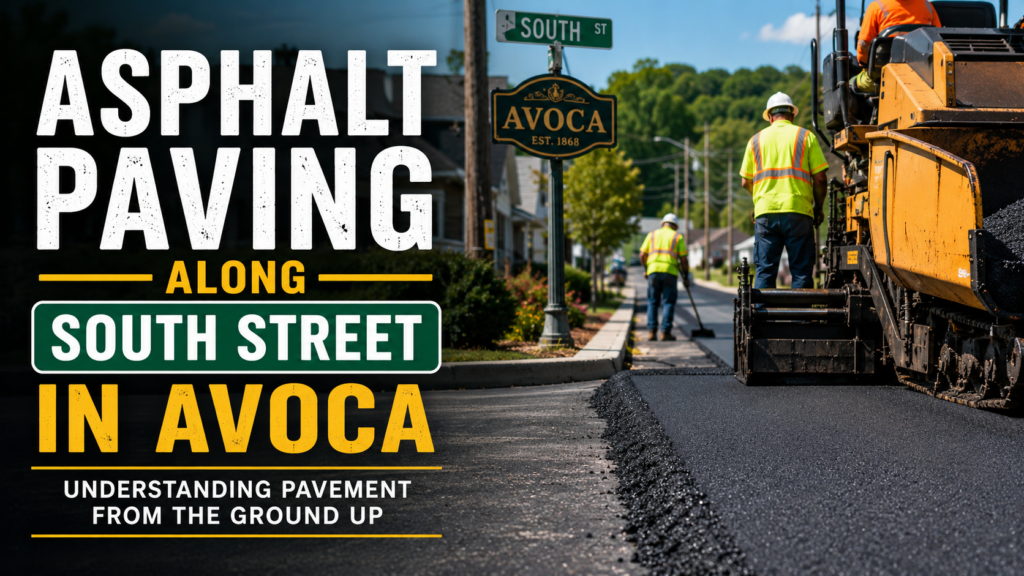
South Street in Avoca, Pennsylvania, is representative of the kind of residential street that defines small borough life in Luzerne County. It is a place of established homes, familiar neighbors, and the quiet rhythms of community life. It is also a place where infrastructure the streets, driveways, and sidewalk edges that frame every property tells a story of age, use, and the ongoing need for maintenance and renewal.
Asphalt paving is at the center of that infrastructure story. Whether it’s a driveway that has served a family through two or three generations, a parking area behind a small commercial property, or a section of road surface that bears the daily wear of local traffic, Asphalt Contractor South Street is the material that makes modern property ownership and community mobility possible.
This article explores the fundamentals of asphalt paving as they apply to neighborhoods like South Street from the composition of the material itself to the way it interacts with soil, weather, and traffic over its service life.
What Goes Into Asphalt: Understanding the Material
Asphalt is a composite material, and its performance depends on the quality and proportions of its constituent parts. Breaking down what asphalt is made of helps explain why some asphalt lasts decades and other asphalt fails within a few years.
Coarse Aggregate: Crushed stone or gravel particles typically larger than 4.75mm (the No. 4 sieve). In Pennsylvania, trap rock, limestone, and slag are common aggregate sources. Coarse aggregate provides the structural skeleton of the mix the interlocking particle framework that bears traffic loads.
Fine Aggregate: Smaller particles (less than 4.75mm) including manufactured sand and natural sand. Fine aggregate fills the voids between coarse particles and contributes to the smooth, compact texture of the finished surface.
Mineral Filler: Very fine particles, often limestone dust or Portland cement, that fill micro-voids and enhance the stiffness and impermeability of the mix.
Asphalt Binder (Bitumen): The petroleum-derived material that coats and bonds all aggregate particles. Binder selection is critical grades that are too soft rut in summer heat; grades that are too stiff crack in winter cold. Performance-graded binders are selected to match the climate at the project location.
Recycled Materials: Modern asphalt mixes frequently incorporate recycled asphalt pavement (RAP) and recycled asphalt shingles (RAS) from roofing tear-offs. These recycled materials contribute usable binder and aggregate, reducing the demand for virgin materials and lowering environmental impact.
The proportions of these ingredients specified in the mix design are engineered to produce a target set of performance properties: stability, durability, impermeability, workability during construction, and resistance to distress under the specific climate and traffic conditions of the project site.
Subgrade Soils and Their Impact on Pavement Performance
Property owners often focus on the asphalt surface itself when evaluating or planning a paving project. But the soil beneath the pavement has an equally significant influence on how well and how long that pavement performs.
Soil behavior varies dramatically depending on soil type, moisture content, and seasonal conditions. Key soil characteristics that influence pavement performance include:
Bearing Capacity: Soil’s ability to support load without excessive deformation. A soft subgrade with low bearing capacity requires either a thick, reinforced pavement structure to distribute loads, or soil improvement before paving.
Frost Susceptibility: Some soils particularly fine-grained silts are highly susceptible to frost action. When these soils freeze, they draw moisture upward from deeper layers through capillary action, forming ice lenses that expand and heave the overlying pavement. Pennsylvania soils frequently include frost-susceptible materials, particularly in low-lying areas along stream valleys.
Expansive Soils: Certain clay minerals absorb water and expand significantly, then shrink when dry. Pavements over expansive clays experience heaving in wet periods and settlement in dry ones a recipe for cracking and surface distortion.
Drainage: Well-drained soils remove excess moisture quickly, maintaining consistent bearing capacity. Poorly drained soils remain saturated for extended periods, particularly in spring, dramatically reducing load-bearing capacity.
Understanding the soil conditions at a specific site and designing the pavement structure accordingly is one of the most important contributions a professional contractor makes. A site assessment that identifies problematic soils allows for appropriate corrective measures during construction, rather than discovering the problem after pavement failure.
The Pavement Design Process
Professional asphalt paving for anything beyond a simple residential driveway involves a pavement design process the engineering of the entire pavement structure to meet the demands placed on it. The fundamental principle is that the pavement must distribute vehicle loads broadly enough that the pressure reaching the subgrade never exceeds the soil’s bearing capacity.
Key inputs to the design process:
Traffic Loading: Typically expressed as Equivalent Single Axle Loads (ESALs) the number of passes of an equivalent 18,000 lb single axle that the pavement is expected to carry over its design life. Commercial properties near South Street that serve delivery vehicles or other heavy trucks require thicker pavements than purely residential driveways.
Subgrade Support: Measured by the California Bearing Ratio (CBR) or the resilient modulus of the subgrade soil. Weaker subgrades require more pavement thickness.
Pavement Layer Properties: The structural contribution of each asphalt layer is quantified by its structural coefficient reflecting the load-distributing capacity of that material. Higher-quality, stiffer mixes contribute more structural capacity per inch of thickness.
Design Life: The intended number of years the pavement should provide acceptable service before major rehabilitation is needed. Typical design lives are 20 years for roads and 15–20 years for commercial pavement.
The result of this process is a specification for the thickness of each layer in the pavement structure aggregate base, asphalt base course, and asphalt surface course sufficient to carry the anticipated traffic over the design life.
Driveway Aprons and Their Connection to the Public Road
One specific aspect of residential paving in neighborhoods like South Street that is worth understanding is the driveway apron the section of driveway that connects the private property to the public street.
The apron zone is subject to forces that differ from the rest of the driveway:
Turning and Braking Loads: Vehicles turning in and out of driveways apply lateral shear forces to the pavement that are absent on straight-running surfaces. These forces tend to push the surface pavement horizontally, contributing to edge deterioration and cracking.
Vehicle Overhang: Larger vehicles delivery trucks, garbage trucks, moving vans that do not fully enter the driveway may park with their rear axle at or near the apron, applying heavy concentrated loads to this zone.
Curb and Gutter Interface: Where a driveway meets a public curb and gutter, there is a transition that must be correctly managed. Improper grades at this transition create water traps or speed bumps that accelerate deterioration.
Municipal Jurisdiction: In Avoca and most Pennsylvania boroughs, the public right-of-way extends several feet beyond the edge of the traveled roadway. Work within this right-of-way including apron construction or modification typically requires a municipal permit. Contractors familiar with local requirements can handle this permitting process on behalf of property owners.
Asphalt and Its Role in Stormwater Management
Stormwater management is a growing concern in communities throughout northeastern Pennsylvania, including Avoca. As precipitation events become more intense, the capacity of storm sewer systems is increasingly tested. Impervious pavement surfaces asphalt, concrete, brick prevent rainwater from infiltrating naturally and contribute to rapid runoff that overwhelms drainage infrastructure and causes flooding.
Property owners considering paving projects have several options to manage stormwater responsibly:
Proper Grading: At a minimum, paved surfaces should be graded to direct runoff toward landscaped areas or designated drainage points rather than toward neighboring properties, basements, or storm drains at rates exceeding what the system can handle.
Permeable Pavement Systems: Porous asphalt surfaces are designed with an open-graded surface layer that allows water to pass through. Beneath the porous surface, a reservoir of open-graded stone stores water until it can infiltrate into the soil below. These systems can virtually eliminate surface runoff from rainfall events up to a certain intensity.
Bioretention Integration: Paved areas can be designed to drain toward planted bioretention cells landscaped depressions that filter runoff through soil and plants before it enters the storm sewer. This approach combines attractive landscaping with stormwater management.
Disconnecting Impervious Areas: Rather than adding new impervious area, some property improvements can redirect existing drainage from impervious to pervious surfaces, reducing net runoff.
Reflective Cracking: When the Old Surface Telegraphs Through the New
A phenomenon that affects paving overlays where new asphalt is placed over existing pavement is reflective cracking. This occurs when cracks in the old pavement surface propagate upward through the new overlay layer, eventually appearing on the surface.
Reflective cracking happens because cracks in the existing pavement are points of movement the asphalt on either side of the crack contracts and expands at different rates during temperature changes, causing repetitive stress at the overlay directly above the crack. Over time, this stress fractures the new overlay.
Strategies to reduce reflective cracking include:
Crack Sealing Before Overlay: Thoroughly sealing all cracks in the existing surface before placing the overlay reduces moisture infiltration at crack locations and partially stabilizes the movement.
Stress Absorbing Membrane Interlayers (SAMI): A flexible, rubberized layer placed between the existing surface and the new overlay absorbs some of the movement at crack locations, slowing reflective crack propagation.
Milling: Removing the top 1–2 inches of existing pavement before overlay eliminates the most distressed surface material and reduces the initial crack depth that must propagate through.
Full-Depth Reclamation: For pavements with pervasive cracking, pulverizing the entire existing structure and stabilizing it eliminates the pre-existing cracks entirely before new pavement is placed.
Conclusion
South Street and the properties along it are part of the living fabric of Avoca a community with roots in the industrial past and a future being shaped by the choices its residents and property owners make today. Those choices include how to maintain and improve the asphalt surfaces that define the accessibility and appearance of every property.
Understanding asphalt its composition, its relationship to the soil beneath it, the design process that determines its structure, and the maintenance strategies that extend its life positions property owners to make informed, cost-effective decisions. Pavement that is well-designed, properly installed, and consistently maintained serves its community for decades, contributing to safety, property value, and neighborhood pride.